

Why Do We Each Experience a Whisky’s Flavor Differently?
For an audio-recorded version of this lesson, click here.
Many assume there’s a single, correct way to describe a whisky’s flavour, and anything outside of this is simply ‘wrong’. But one person’s marzipan is ripe cherry to another, and neither is wrong. Far from it – the variety of aromas we perceive is a feature, not a game of right-and-wrong
Understanding why we each experience a whisky’s flavour differently is therefore not only important to understand, but it’s central to enjoying whisky altogether. In this lesson we shall explore the key reasons that set our sensory experiences apart from one another. It will help you to explore flavour in the true spirit of the SMWS – with a sense of adventure, endless discovery, friendship and fun.
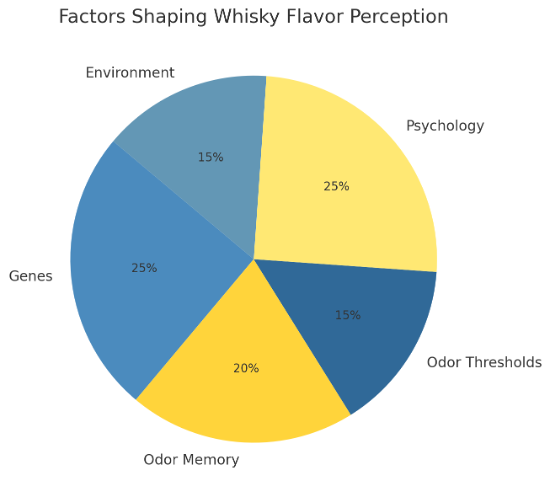
How Your Genes Dictate Whisky Flavor Perception
Each of us carries around 800 or so genes for odor receptors – the receptors in the nose that detect airborne molecules before sending signals to the brain. But not everyone’s set is identical. Odor receptor genes regenerate around every 40 days but are prone to making copying mistakes. What does this mean?
Some odor receptors switch off entirely; whilst others change their shape, subtly altering what they can detect. The remarkable discovery is that on average we each have a 30% difference in our odor receptor genes. This is why some people are ‘blind’ to smelling certain odors such as coconut, sulphur, or banana, for example. It’s also why coriander is either the world’s freshest herb or the most unpalatable soap. It’s all a case of genetics. But there’s more.
Why Your Odor Memory Is Crucial
When you sniff a dram, memories pop into your head as your brain attempts to match the molecules to previous experiences. The images that are pulled from your memory of odors when smelling are called odor objects. For example, if you smell coconut, you will have an accompanying mental image of a coconut. But, like all memories, they are personal to each of us.
Familiarity is important too, and this is shaped by culture. The more familiar we are with certain odors the more easily we can identify them. If you grew up surrounded by coconut trees, it’s likely that you will be able to spot – or sniff – coconut in a whisky instantly. Conversely, someone who has never experienced coconut will not be able to identify its smell in the same way.
Why Whisky Flavor Is a Chameleon
When reading whisky tasting notes, the flavor of that dram will be portrayed as a single moment in time. But this is not how flavor works. That measure of golden nectar in your glass is in a state of constant flux – morphing and changing like a chameleon inside a kaleidoscope. Especially as you take a sip.
Once the whisky enters your mouth it transforms into a different mixture on a chemical level. Firstly, it becomes diluted with saliva, reducing its concentration of alcohol. It will also become heated, which will release a different mix of odor molecules into the air before they find their way into your nasal cavity. But it gets more complex too.
The ph of your mouth will have an impact. Plus, the oral enzymes and microbiota, that are unique to you, will create chemical reactions that will either alter molecules in the whisky or create new ones. So in essence, your mouth changes the dram into a different chemical mixture in ways that no one else can replicate.
Odor Thresholds And Whisky
Such individual differences combine to create something called odor thresholds. An odor threshold is the lowest concentration of a substance in air (or solution) that can be reliably detected by your nose. In simple terms, if you have a low threshold for let’s say coconut, you will be sensitive to it and pick it up in whisky very easily.
Everyone has different thresholds for every possible odor and flavor. You will be sensitive to some odors, but not so much for others. The fascinating part is that odor thresholds change constantly throughout the day. Depending on your emotional and physiological state, your thresholds will go up and down. You may have noticed this when the same whisky tastes different on consecutive days.
How Psychology Changes Whisky’s Flavor
The experience of flavor is also heavily influenced by psychological factors such as environment, occasion, and expectation. Research has demonstrated how the perception of flavor can be enhanced in shared social settings and that mood has a direct impact on flavor perception too.
Expectation is a fascinating topic, however. Everything from packaging and bottle design, to pricing, scarcity, and age will prime your brain to anticipate certain qualities and characteristics. Again, this will be unique to everyone based upon prior experience and knowledge.
The Final Whisky Tasting Lesson
As should now be apparent, there are many reasons why we each experience a whisky’s flavor differently. In fact, when you look at flavor, it’s remarkable that we should agree on the character of whisky at all. But this subjectivity and individuality is what The Society is all about. Embrace it and share it, safe in the knowledge there are no wrong answers.
Join us for our next lesson: Your Guide To Sensory Analysis and The SMWS Panels. Or to discover more, including how to join our online course on learning the sensory science behind professional whisky tasting, follow this link to The Sensory Advantage.